How 6b6t Reached Over 1,155 Players Without a Queue
Over 1,155 players online at once, with no queue. How 6b6t put more than 1,000 of them inside one Minecraft world, what held up and what broke.

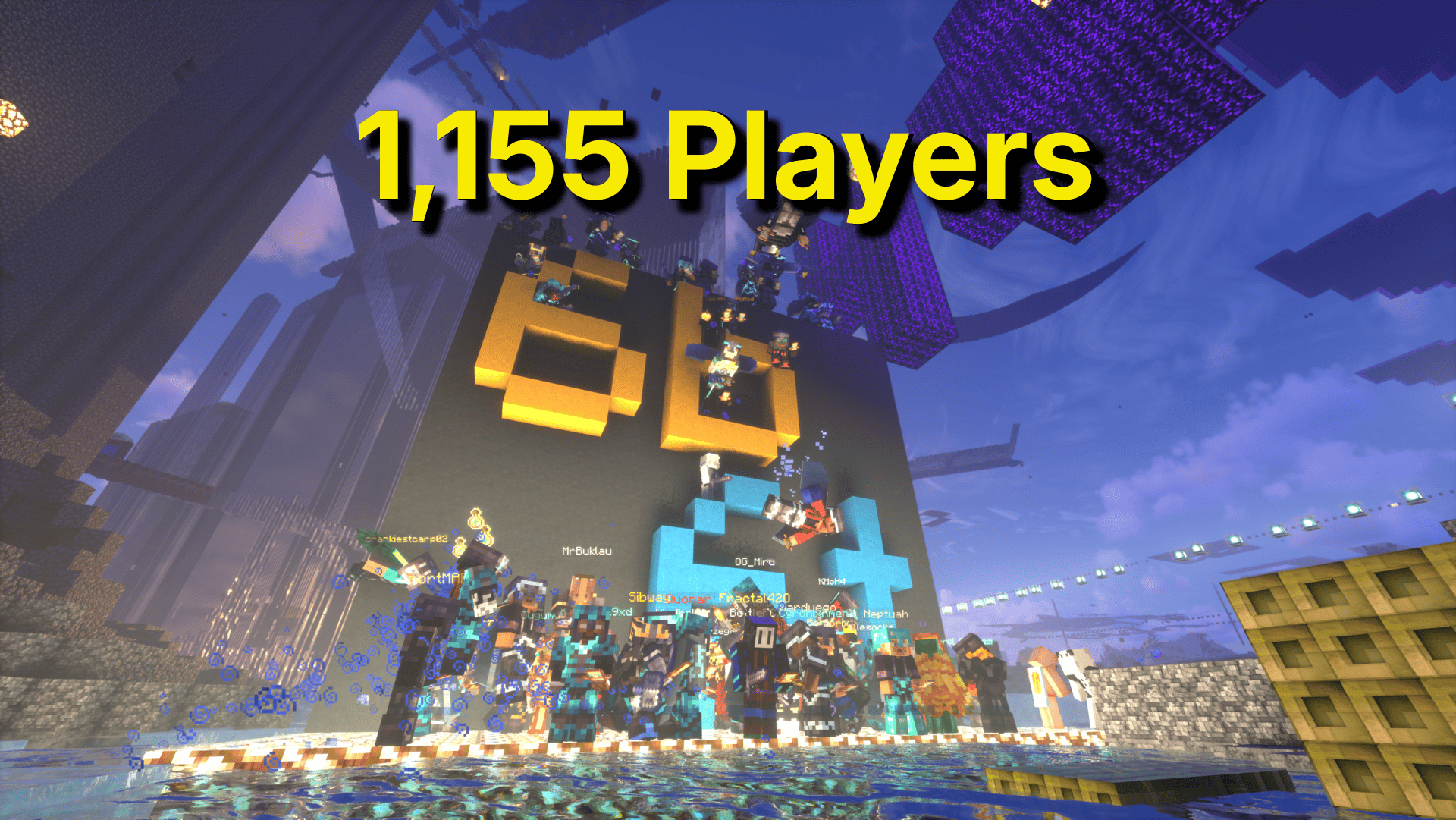
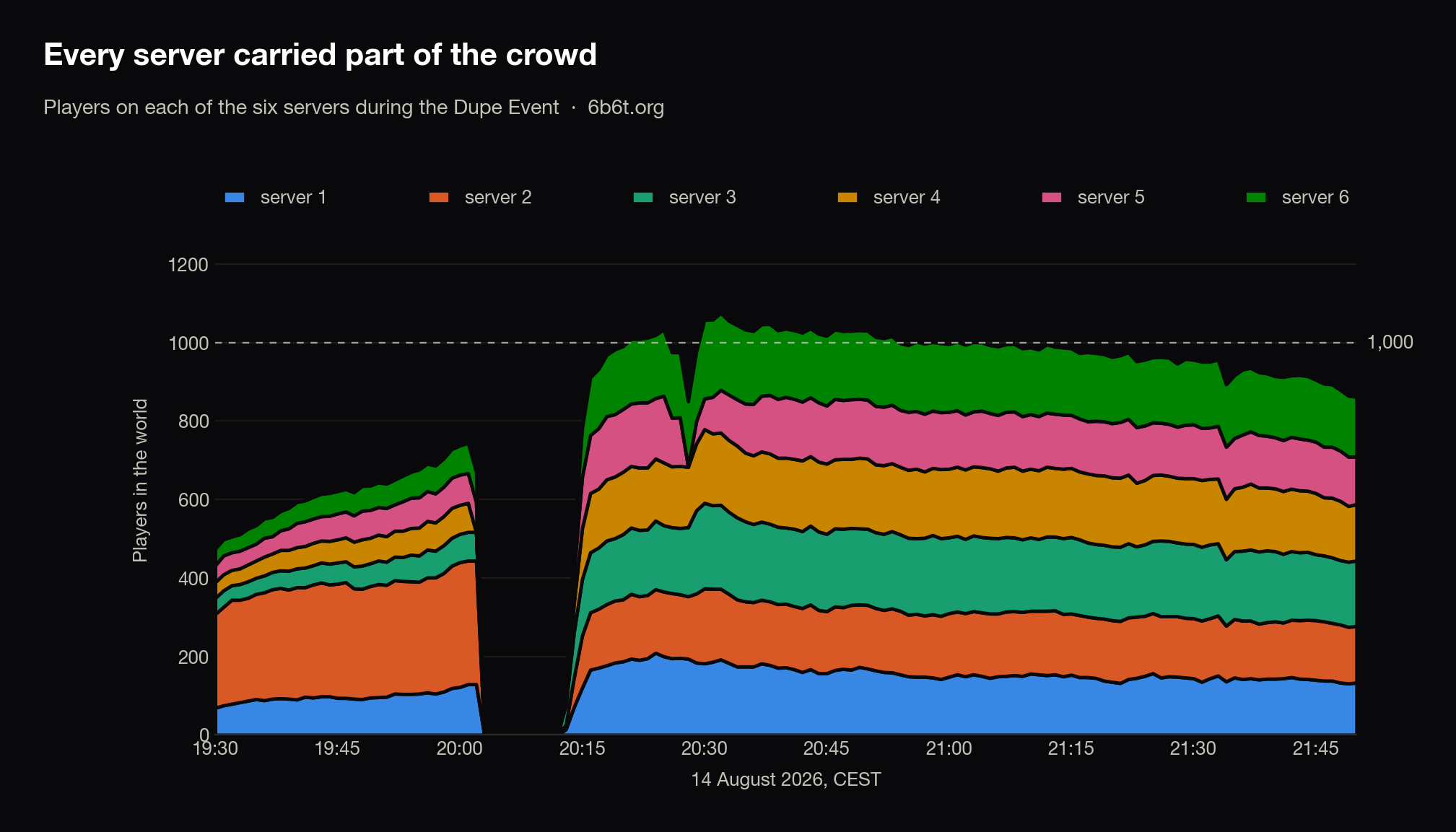
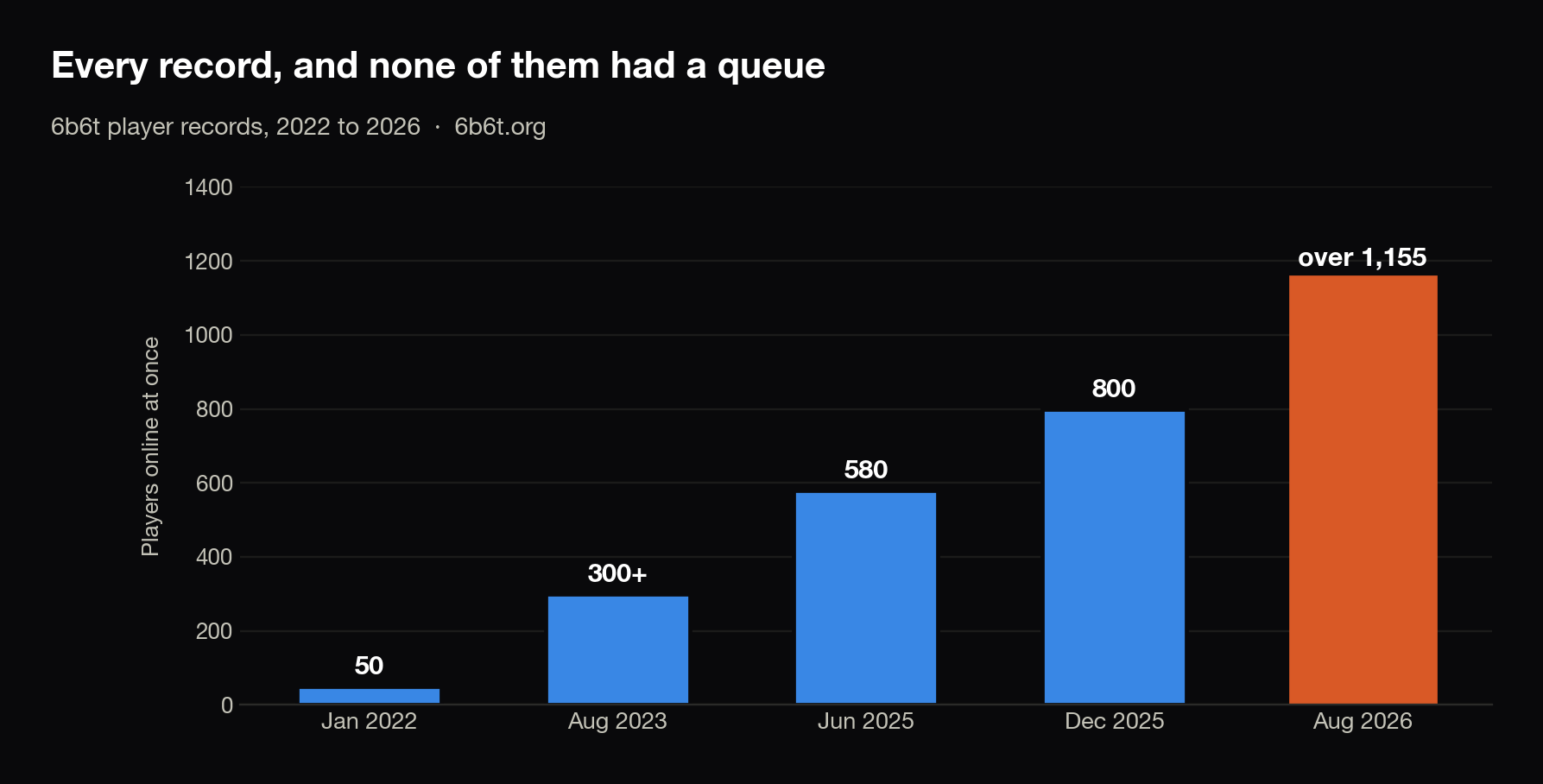
On August 14th at 20:00 CEST, the 6b6t Dupe Event began. Within minutes, more than 1,000 players were online. Shortly after, 6b6t reached a new all-time record of over 1,155 players online.
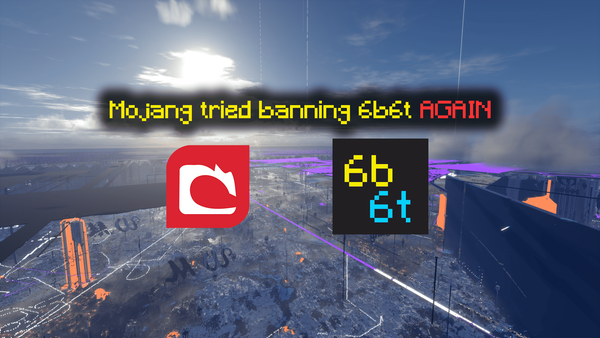
This happened one month after Mojang blacklisted 6b6t.
Nobody waited in a queue. Nobody was turned away because the server was full. Mojang tried to stop 6b6t. One month later, more players were connected than ever before. Mojang failed and 6b6t succeeded instead.
At 20:30, 1,062 players were inside the game world at the same moment. They were spread across six Minecraft servers on six separate machines, all playing in one world.
In January 2025, we published how 6b6t plans to reach 1,000 players online. In 2026, even after the blacklist, 6b6t reached 1,155 players online at once. This is how we did it, what held up, what broke and what we learned.
The Night of August 14th
At 20:00 CEST, we restarted the server to switch the dupes on. 815 players stayed connected on our backup server. Nobody had to rejoin. When the world came back after the restart, everyone on it was sent straight in.
What followed was the biggest night in 6b6t history:
- 20:00: the Dupe Event starts.
- 20:14: more than 1,000 players are online.
- By 20:15: the server is running very smoothly.
- 20:25: one of the six servers crashes. It is back two minutes later.
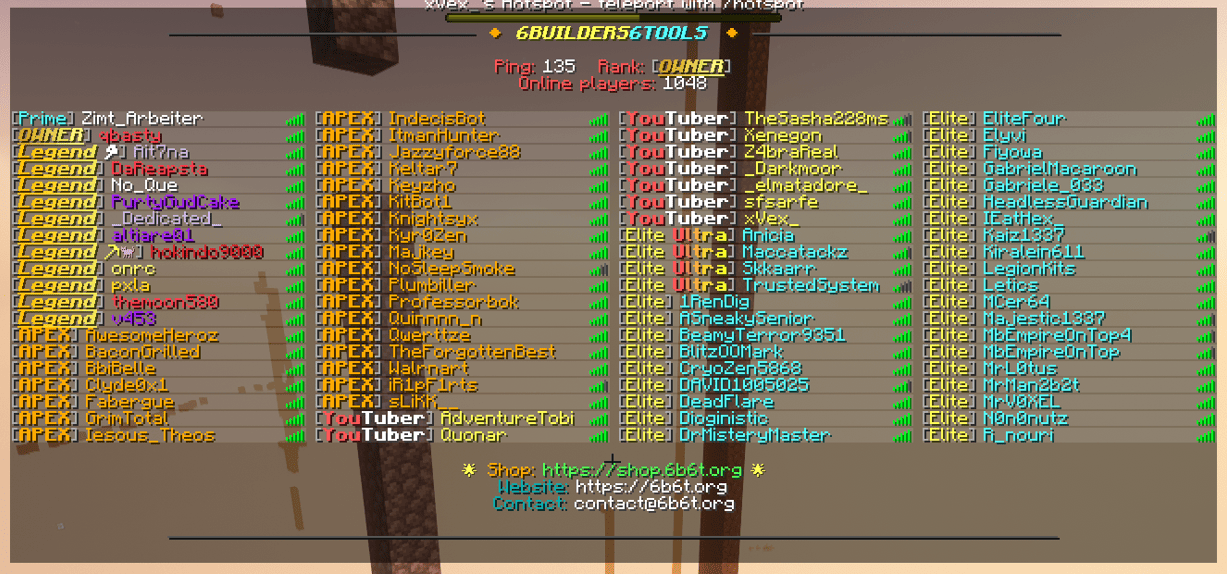
- 20:30: 1,062 players are inside the world at the same moment, split 185 / 186 / 215 / 183 / 93 / 200 across six servers. The rest are still logging in, on the login and lobby servers.
- 20:46: over 1,155 players are online, a new all-time record.
Between 20:00 and 02:00, 2,964 different players connected to 6b6t, and 2,732 of them played in the world.
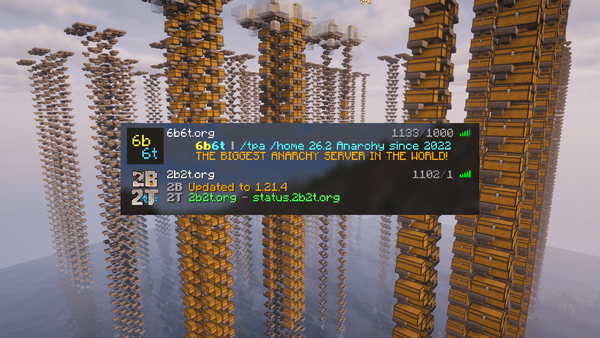
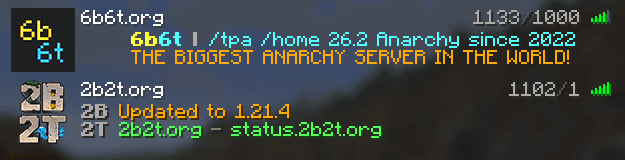
That same evening, 6b6t passed 2b2t on the public server list. Both servers count every player who is connected, even the ones who are not in the world yet. On 2b2t those players are stuck outside and cannot get in. Only about 500 to 600 are really in the world. On 6b6t they are just logging in, and they are in the world a few seconds later.
How It Held Up
Most of the world ran at full speed. Around the peak, the typical area on every server ran at 20 TPS, Minecraft's normal speed. No single area held more than about 50 players, because players spread out across spawn, bases, highways and the rest of the map.
The worst lag wasn't caused by players. A few areas with only one to five players in them held between 100,000 and 224,000 entities, almost all of them duped items. Those areas slowed down heavily. That's what happens when an entire server dupes at once.
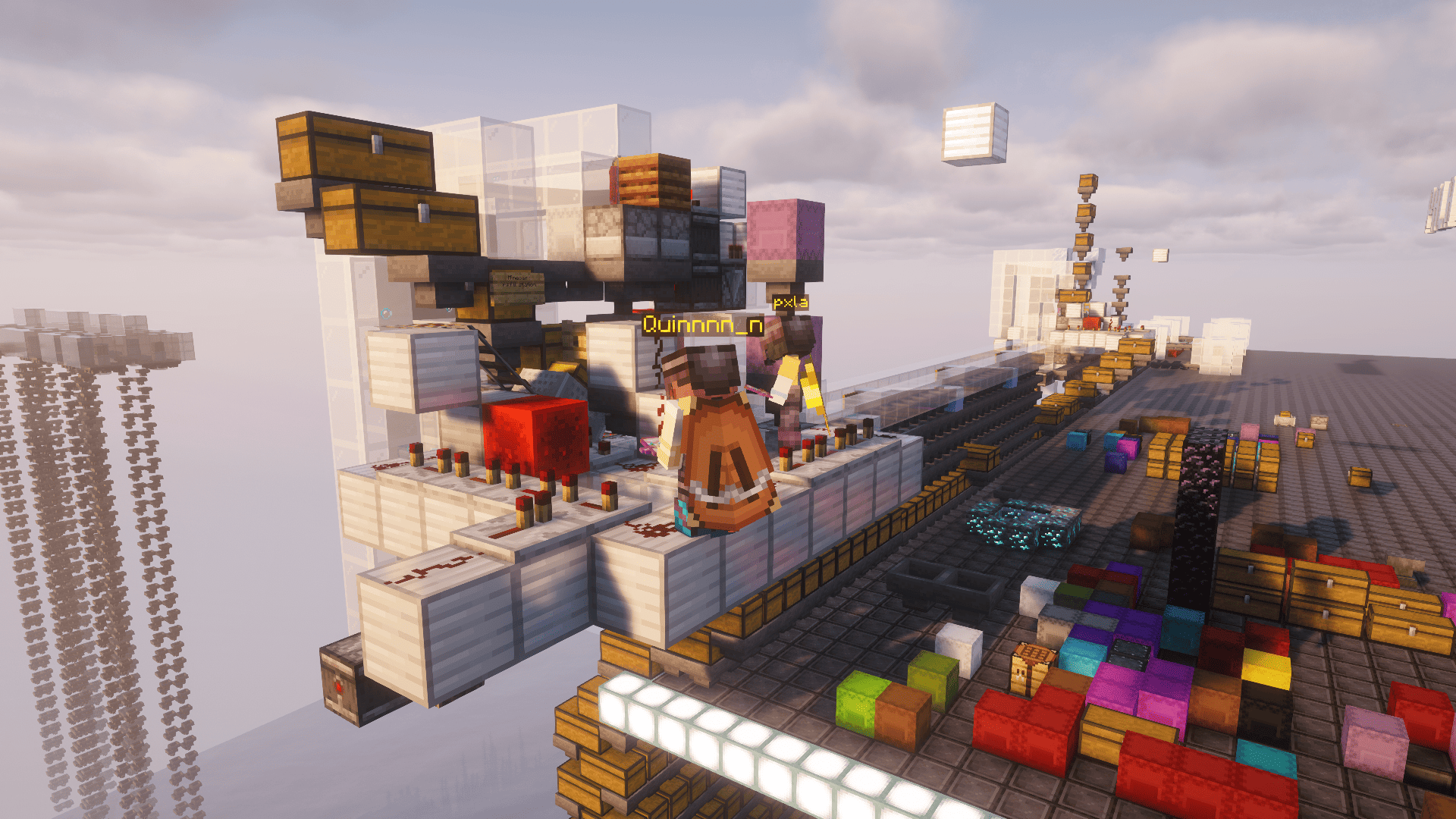
There were joining issues. Some players had to try more than once to get in.
One of the six servers crashed at 20:25. It was back two minutes later.
It wasn't perfect. But it was the first time 6b6t passed 1,000 players. It was also the first real test of years of work on our own server technology. 2b2t has never done something like this.
Who Those 2,732 Players Were
A month earlier, Mojang had put 6b6t on Minecraft's blocked-server list. TheMisterEpic covered it, and their video passed 375,000 views. A video by a 6b6t player and YouTuber, raincoates, has over 160,000 views. Posts on Reddit gained hundreds of thousands of views about the blacklist of 6b6t. The Dupe Event was the perfect opportunity for thousands of new players who have just heard about 6b6t to come online.
6b6t promoted the event and the blacklist very heavily too. Between August 1st and August 14th, 6b6t posted 8 YouTube shorts and the entire channel gained 171,536 views.
TheMisterEpic covering the blacklist in July 2026. MasicoreLord, quoted later in this post, came back to Minecraft because of this video.
MasicoreLord, a 6b6t player, watched it. They had been away from Minecraft for a long time. They installed AnarchyMod, the free mod Java players need to get past Mojang's block, and joined 6b6t for the first time because of a video about the server being banned. On August 14th they were one of the players in that record.
tactiquevertical was there too. They had spent three days preparing a main stash and backups, and still misjudged the scale:
"I did overshoot and duped way more shulkers than I could fit in chests so I ended up spending three of the ten days lagging and throwing shulkers into lava."
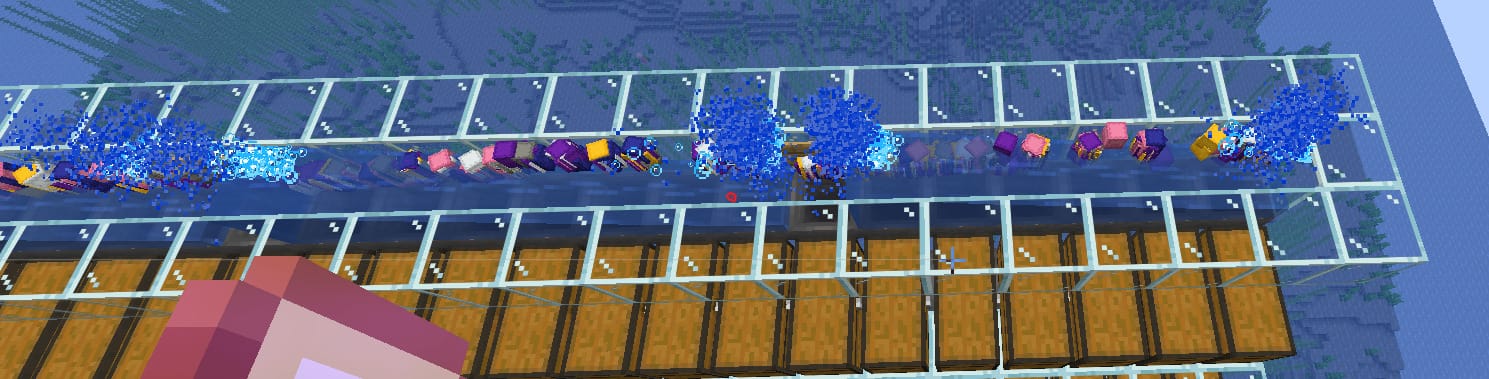
That is what over 1,155 players online actually looked like from the inside. Now here is how they all fit in one world.
Hardware Alone Doesn't Solve It
For the event, we temporarily extended our infrastructure by a lot. 6b6t ran on 10 dedicated servers with 1,632 GB of RAM combined. That was four AMD Ryzen 9 9950X, two Ryzen 9 7950X, one AMD EPYC and one Intel Core i9-14900K, plus two storage servers holding more than 200 TB. The 6b6t map alone is over 60 TB. Six of those machines ran the game world itself. The rest stored it and connected players to it.
That's far more than a normal Minecraft server has. But hardware isn't what makes 6b6t scale.
You can't give a normal Minecraft server a terabyte of RAM and expect it to handle 1,000 players. Vanilla Minecraft does most of the world's work on one main thread. The hard part is making Minecraft use many CPU cores, many processes and many machines, while everyone still plays in the same world.
Folia Is the Starting Point
6b6t is built on Folia, made by the PaperMC team.
Folia splits the loaded world into independent regions. Regions that are far enough apart are processed at the same time, on different CPU threads. Spawn, a base, a farm and a highway thousands of blocks apart can all run in parallel.
That's a huge improvement for a server like 6b6t, where players are spread across millions of blocks. PaperMC itself says Folia helps most when players are spread out.
But a Folia server is still one process on one machine, with a limited number of CPU cores and a limited amount of memory.
That's where Fox comes in.
One World, Many Servers
Fox is our own server software, built on top of Folia. It takes Folia's idea of splitting the world and extends it across several Minecraft servers. Each one is a complete Folia server. We call them workers.
During the event, 6b6t ran:
- six workers, each on its own machine. The last three went live about 80 minutes before the event started.
- three proxies in front of them, running FasterVelocity, our open-source fork of PaperMC's Velocity. A proxy is what your game connects to, and it passes you through to the right server.
- one coordinator, which keeps all of them in agreement.
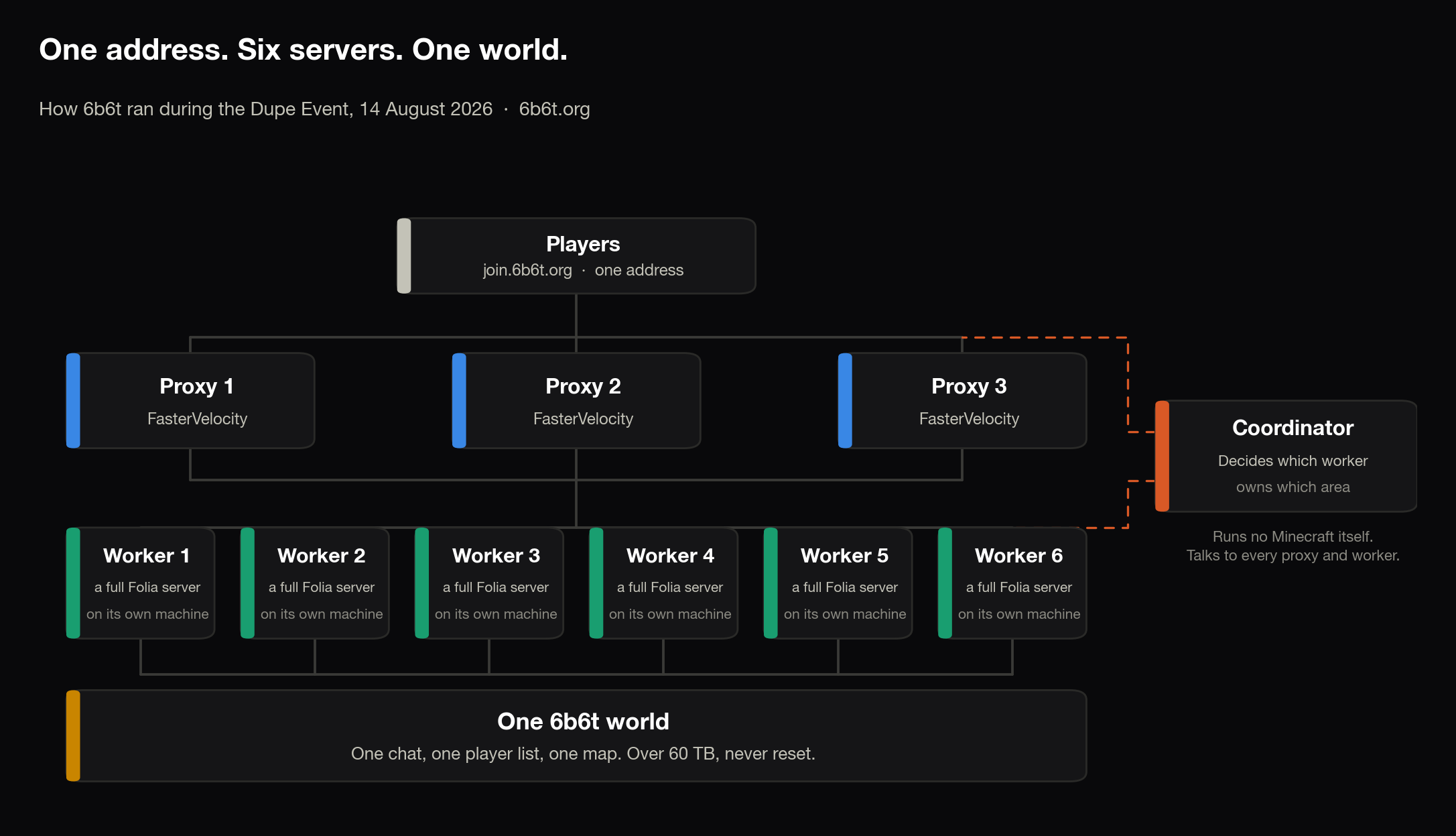
Players still connect to one address. They don't pick a server, and they don't join separate copies of the map. There is one 6b6t world, one chat and one player list. Behind the scenes, different parts of that world run on different machines.
Every Area Has Exactly One Owner
Two servers can't safely change the same part of the world at the same time. So Fox always needs one answer to a simple question: which worker is in charge of this area right now?
Fox splits the world into fixed areas of 512×512 blocks, the same grid Minecraft uses for its region files. Each area has at most one owner at a time:
- Areas nobody is using have no owner.
- When players walk into an empty area, their worker claims it.
- When someone logs in or teleports, Fox sends them to the worker that owns that area or the areas around it, or to a worker with room.
- Spawn has its own dedicated worker.
- Fox never takes an active area away from a worker just to balance the load. Stable ownership matters more than a perfectly even split.
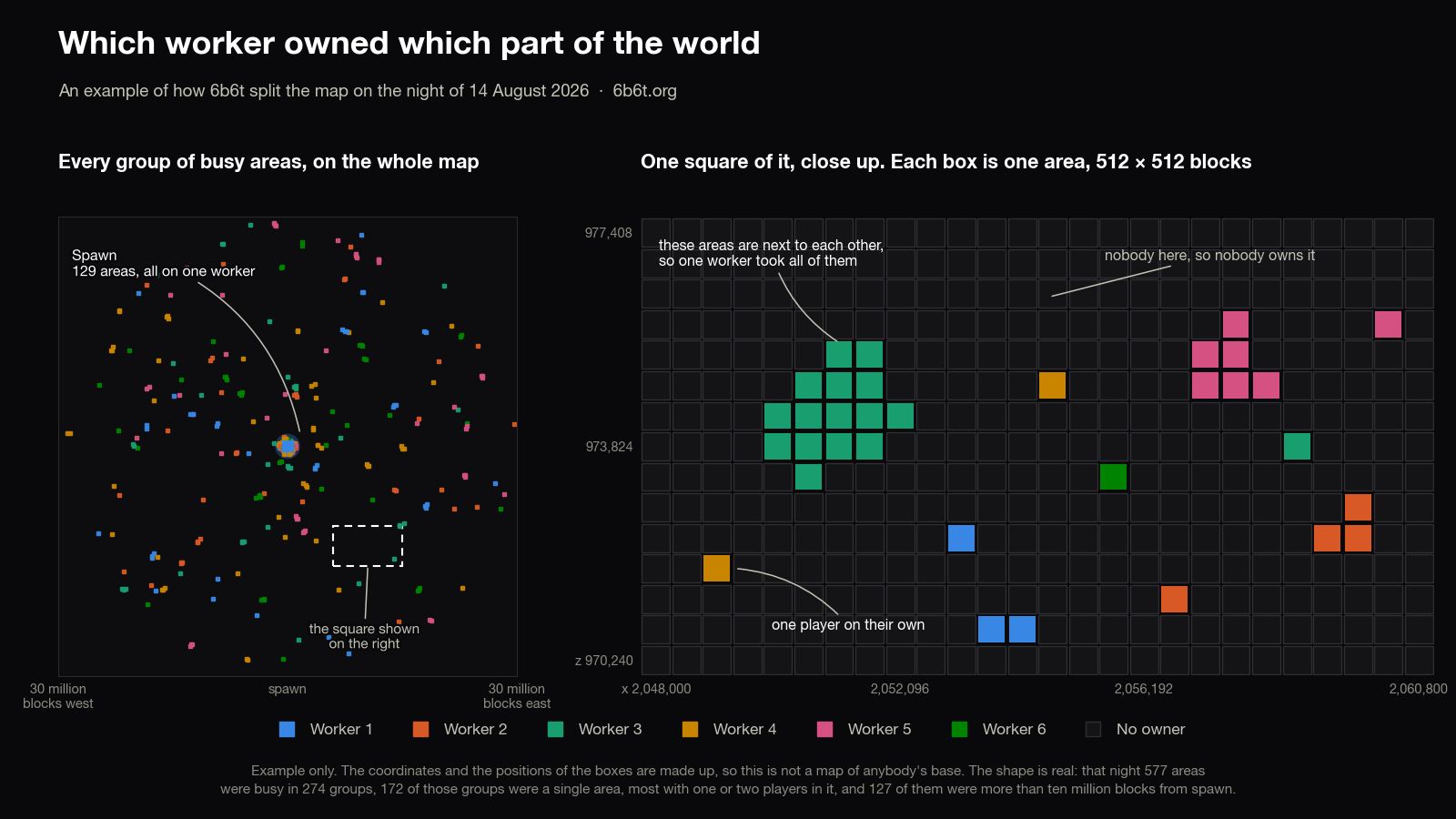
These decisions are made by the coordinator. It doesn't run any Minecraft itself. Blocks, mobs, redstone and players all run on the workers. The coordinator decides who owns what, which worker each player belongs on and which workers are online, and it stores the world.
Walking From One Worker to Another
Most of the time, walking around doesn't change your worker. But when you walk toward an area another worker owns, Fox moves you there without you ever leaving the server:
- Your worker asks the coordinator who owns the area ahead.
- Your player data is saved.
- The proxy switches your connection to the other worker.
- That worker loads you in, and you keep playing.
The move starts a few blocks before you reach the border. If saving your data fails, the move is cancelled and you stay where you are. Nobody is ever sent on with half their data.
On your screen, it looks like switching servers on any Minecraft network: a loading screen, then you carry on from the same spot.
Teleports work the same way. If your /tpa or /home destination is on your worker, the teleport stays local. If it's on another worker, Fox prepares the move first. Portals follow the same path.
In the six hours after the event started, players moved between workers 6,370 times. Only four of those moves were stopped by a safety check, and those players simply stayed where they were.
Two Workers Can Never Save the Same Base
This is the most dangerous part of running one world on several servers.
Imagine two workers both believe they own the same base. A player breaks a chest on one while another player changes the same chunk on the other. Both save a different version of the same place. That can never be allowed to happen.
So in Fox:
- Every area has exactly one owner at a time. When an area moves to another worker, the old worker loses the right to save it, and anything it still tries to save is rejected.
- Workers never write the world files themselves. They send every save to the coordinator, which stores the world.
- Every save is checked before it's accepted. It has to come from the current owner, build on the latest version of that area and match its checksum.
- A save only counts once it's safely on disk.
That's the difference between putting a few Minecraft servers behind a proxy and making several servers run one shared world.
Restarts Without Kicking Everyone
Servers still need restarts, for updates or when something goes wrong. When that happens on 6b6t you are not disconnected. You are moved to our backup server, which holds your connection open while the world restarts. There is no line and no position: everyone on it goes back in together, the moment the world is ready. That is what happened to the 815 players at the start of the Dupe Event.
Plugins That See the Whole Network
Splitting Minecraft is only half the job. A normal plugin only sees the players on its own server. On 6b6t:
- global chat has to be global
/tpahas to find players on every worker- homes have to work wherever they are
- the player list has to show everyone
For that we built FoxLib, a plugin API that understands the whole network. Chat, teleport requests, group chat, gifts, hotspots, cosmetics and more all run through it.
You never need to know which worker your base is on.
Kubernetes Runs the Machines
Fox decides which worker owns which part of the world. Kubernetes, the software that runs our machines, decides where the workers themselves run: it starts them, puts them on machines, checks they are healthy and handles their storage. That's how we went from three to six workers in the 80 minutes before the event started.
Every worker reports to the coordinator about once a second: tick speed, players, loaded chunks and entities. Our dashboard shows it live, and every log is collected in one place. That's where the numbers in this post come from.
Over 1,155 Spread Out Isn't the Same as 400 in One Spot
On August 14th, no single area held more than about 50 players.
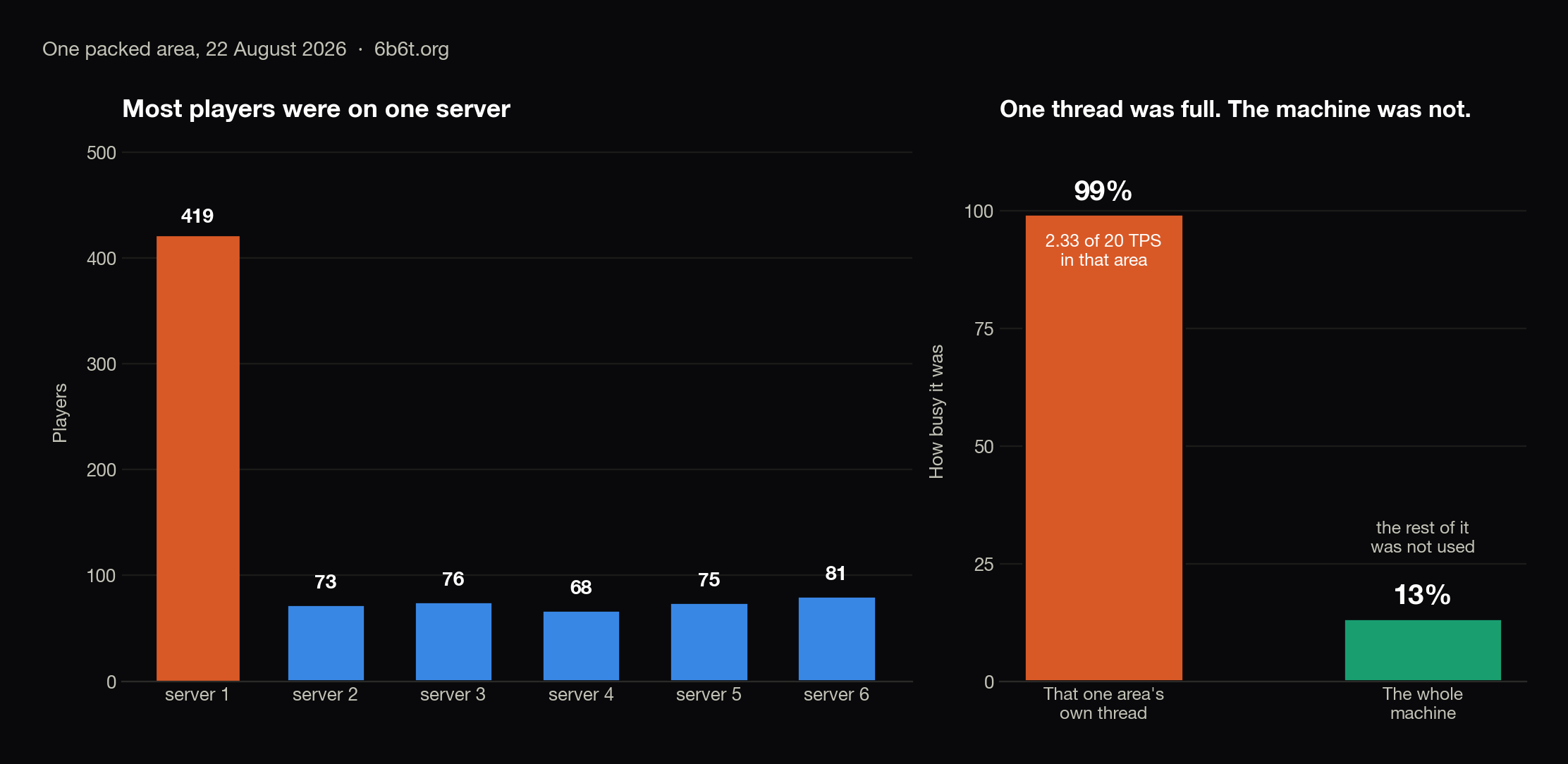
Eight days later, on August 22nd, The Horizon streamed live on 6b6t for two hours. The Horizon is a Minecraft YouTuber with more than 750,000 subscribers. Hundreds of players came with the stream, and most of them went to the same place: spawn, the destroyed area where every new player starts. Here's how it looked:
- 805 players were in the world.
- 422 of them were on the worker that runs spawn.
- One single area held up to 393 players, along with more than 84,000 entities.
That area ran at about 2.3 TPS. Normal is 20.
At the same time, that machine was using only about 13% of its CPU. The typical area on that worker, and on every other worker, was still running at close to 20 TPS.
The whole stream is still up, and the crowded part is easy to spot: the chat never stops moving.
The Horizon's two-hour stream on 6b6t, August 22nd.
Why? Folia runs each region on a single CPU thread. When hundreds of players, their items and their fights are packed into one spot, that work can't be split without breaking how Minecraft works. One thread ran at its limit while the rest of the machine had room to spare. Fox can put different busy areas on different workers, but it can't split one packed spot between machines.
These two nights show both sides of the same design:
- Over 1,000 players spread across a huge world is exactly what Folia and Fox are built for.
- Hundreds of players in one spot is a different problem. More machines don't fix it. Making one crowded spot cheaper to run does.
We said on the day that the server had a lot of trouble with that crowd. This is exactly what was happening.
What We Changed After Horizon
- Every area now gets its own owner. Since September 14th, each 512×512 area is claimed on its own. Before, Fox moved groups of nearby players onto the same worker so their areas shared an owner.
- The heavy work got cheaper. Ticking chests, furnaces and other block entities, saving chunks and loading new areas all got faster.
- Saving got more reliable. Most of our recent work has gone into storage: faster saves, and saves that hold up through restarts.
This Took Years, Not One Event
The technology behind August 14th didn't appear a week before the Dupe Event.
- 2020: while running an earlier anarchy server, we came across WorldQL. It was the first inspiration for one Minecraft world spread across several servers. The 6b6t owner, qbasty, decided back in 2020 that he will cross 2b2t's player count but with no queue. The 6b6t team always believed the queue wasn't necessary.
- December 2022: 6b6t moved to MultiPaper, an early way of splitting one world across servers. It worked, but it caused serious problems, especially with dupes.
- June 2023: we switched to Folia and started modifying it heavily.
- September 2024: we said publicly that we wanted to take 6b6t to 1,000 players.
- January 2025: we published our plan to get there.
- December 2025: the world was split across several machines, and 6b6t set a new record of 800 players, however with a ton of restarts and lag.
- May 2026: we rewrote the coordinator in Rust, and our server software got its current name: Fox. Before that, it was called MultiAbomination.
- July 2026: we open-sourced FasterVelocity, our proxy. On July 15th, Mojang blacklisted 6b6t.
- August 14th, 2026: over 1,155 players online, with no queue.
We Could Have Sold a Queue
When a Minecraft server gets more players than it can hold, there is a standard answer. Put them in a line, and sell a way up it.
2b2t does both. The queue takes about two days from the back, and priority costs $19.99 a month. Priority does not skip the queue. It is a second, shorter one. We wrote up how that queue works and why it exists separately.
We could have done that. It is the cheaper path by a wide margin. A queue is a few hundred lines of code, and it turns your busiest night into your best sales night. According to player reports, based on data that leaked from 2b2t's plugins in the past, priority queue sales made 2b2t up to $50,000 a month.
We chose the other option. 6b6t spent four years building the technology to let everyone in instead. Our ranks give cosmetics and other extras, and you can earn them by voting rather than paying. None of them sell a shorter wait, because there is no wait to sell.
A queue is what a server does when it has run out of engineering. We would rather keep running out of machines.
If you are weighing the two up, we keep a straight comparison of the two servers and a wider list of the alternatives.
What Comes Next
Passing 1,000 players doesn't mean scaling is solved. The biggest challenge left is the one Horizon exposed: hundreds of players in one spot.
6b6t has always promised No Rules. No Queue. No Lag.
On August 14th, No Queue held with over 1,155 players online. Horizon showed us exactly where No Lag still needs work.
Anyone can change a max-players number in a config file and advertise it. What matters is having those players actually connected and playing together in one permanent world. That's what Fox is built for.
On a normal day right now, 6b6t runs at 200 to 300 players online, with peaks approaching 400. An event night is a different thing entirely. So here is what we are aiming at next, and both halves matter:
- 2,000 players online at peak, with no queue.
- 1,000 players online on an average day, with no queue, with no lag, with extremely high render distance.
The second one is harder than the first. A peak is one night. An average is every night.
What 2,732 Players Did With That Night
A record is a number. This is what some of the players inside it were doing.
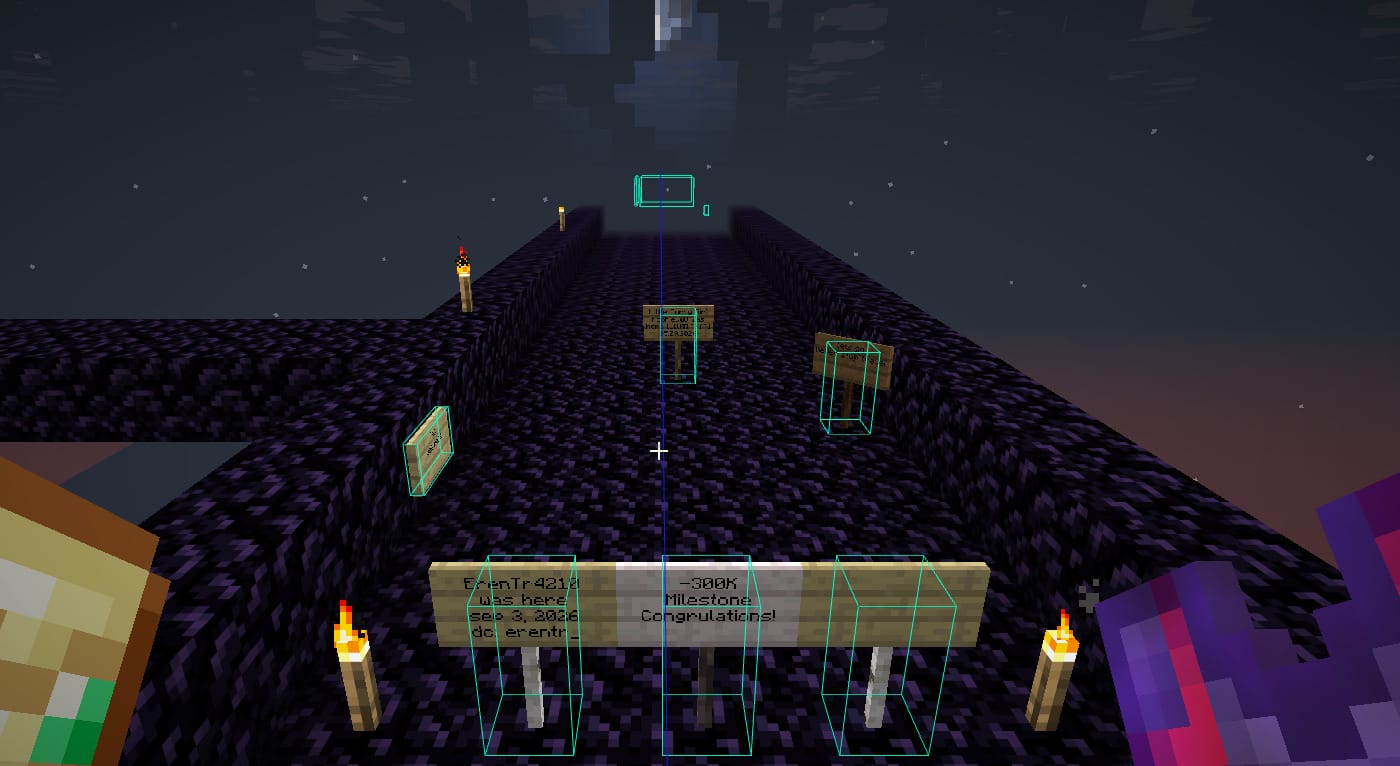
Remember MasicoreLord, who came back to Minecraft because of a video about 6b6t being banned. During the event they duped obsidian, then went out to the mid-sky west highway. The built stretch stopped just short of -300K, and that bothered them enough to fix it. They extended the highway about 15,500 blocks to -300.5K, bridging around a half-destroyed portal hub on the way. Other players have since carried the route further, the way the players who built the original highways did before them.
"I wanted to try to leave something somewhat permanent on the server, as I know things like stashes or bases rarely last."
Devxon_ spent the night working on stashes with friends and starting a build they had been planning for a while, and came out of the event in a clan.
"I made a lot of friends along the way that I did not expect to be friends with such as N0QUE and then I got selected to be in their clan, and I am still a part of it."
That continues long after an event ends. plainprincedev got started on 6b6t because a stranger's furnace was there when they needed it. They now leave furnaces stocked with wood and iron around spawn for players they will never meet: "just helping new people around :D".
FAQ
Was There a Queue?
No. Nobody was turned away because the server was full, and nobody was put in a line to get in. During a restart you are held on our backup server with your connection open, and you go back in when the world does. A queue makes you wait for someone else to leave. Nothing on 6b6t does that.
What Happens at a Border Between Two Workers?
You can see the terrain on the other side, but not the players, mobs or items there until you cross. That terrain comes from the saved world, so it can be slightly behind what's happening over there. When you walk across, Fox moves you to the worker that owns that area, and you see a loading screen.
What Happens if a Worker Crashes?
Its players are moved to the backup server and sent back as soon as it's ready. Its areas stay locked in the meantime, so nothing can overwrite them.
Is Fox Open Source?
No. Fox is completely customised for 6b6t and isn't built to be used by other servers. It also gives 6b6t an advantage over Minecraft servers that need a queue: 6b6t promises to never have one.
- Record: over 1,155 players online at once, on August 14th 2026, with no queue.
- On a normal day: 200 to 300 players online.
- Opened: January 16th 2022. The world has never been reset.
- Map size: over 60 TB.
- Queue: none, ever.
- Rules: no rules, unlike 2b2t.
- Java:
join.6b6t.org, with AnarchyMod. - Bedrock:
br.6b6t.org, port19132, no mod needed.
Last checked 25 September 2026.
Join 6b6t
Java players need AnarchyMod to get past Mojang's blacklist: https://www.6b6t.org/mod
Mojang had the mod taken off GitHub in September and they continue to fight 6b6t. It is still free, still open source, and the download above still works.
Java IP: join.6b6t.org
Bedrock IP: br.6b6t.org
Bedrock Port: 19132